
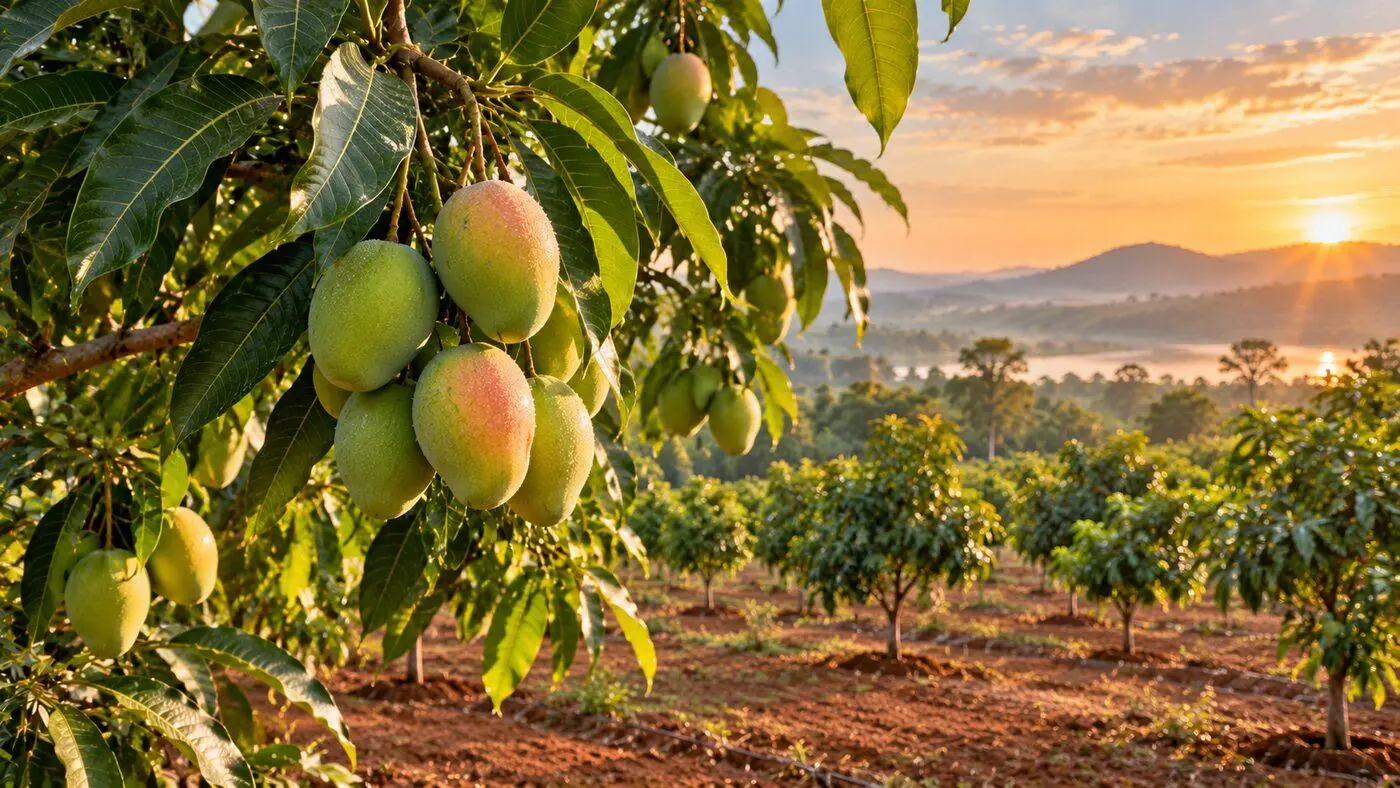
Every Vankunj plot comes with its own mango trees, and the variety we chose is Amrapali, one of India’s best known hybrid mangoes. We wanted a tree that suits a farm plot rather than a large commercial orchard, and that gives a family something to look forward to each summer.
A variety made for smaller plots
Amrapali was developed at the Indian Agricultural Research Institute by crossing Dashehari and Neelum. The tree stays dwarf, and it is widely recommended for high density planting. On a farm plot that matters, because the trees can grow well without crowding your farmhouse area, and a smaller tree is easier to look after and to pick from.
Fruit year after year
Many mango varieties fruit heavily one year and lightly the next. Amrapali is known as a regular bearer, so your trees are more likely to give a steady crop every season. The fruit is sweet with deep orange flesh and is good for eating fresh. It also matures later than many common varieties, so it can extend your mango season.
What a young plantation needs
Young mango trees need more attention than mature ones. These are the things that decide how well they establish.
- Regular water in the first years, above all through the hot Vidarbha summer
- Mulch and weeding around the base, to keep moisture in and competition down
- Early training and pruning, to give the tree a strong, open shape
- Watching for common problems such as mango hopper and powdery mildew around flowering time
- Pruning as the years go by, because dwarf trees planted close together can get crowded
What to expect, year by year
In the first years you are mainly watching the tree settle in and fill out. Fruit builds up gradually as the tree matures, and how much you get depends on the tree’s age, the weather and the care it receives. It is best to think of your plantation as shade, green cover and fresh mangoes for your family, rather than as a source of fixed income.
Green cover that grows with you
Beyond the fruit, a mango plantation gradually turns your plot into shaded, green land. It cools the ground around a future farmhouse, brings birds back to the land, and makes each visit look a little different from the last. We maintain the plantation for the first three years at no extra cost, so it is well on its way by the time you are ready to build.